




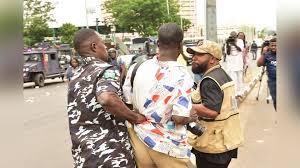

The Wole Soyinka Centre for Investigative Journalism (WSCIJ) has blamed the Nigeria Police Force (NPF) and politicians for over 70 per cent of harassment and risks faced by Nigerian journalists, particularly during elections and civic demonstrations.
The Centre’s Chief Executive Officer (CEO), Motunrayo Alaka, presented these findings on Wednesday during the 2nd Edition of the Civic Space Guard Conference, focusing on AI, press freedom, civic space, and the future of investigative reporting in Nigeria, held in Abuja.

“For perpetrators of infringement, we see that politicians and the police are responsible for 70 per cent of cases from what we researched,” she stated. “It’s an aberration when institutions overseeing elections also harass journalists in the line of duty.” 
Mrs Alaka said that 90 per cent of recorded attacks on journalists happened during reporting assignments. The 2023 Journalism and Civic Space Research, which the WSCIJ will soon launch, examined incidents by month, state, and type of harassment or violence.
“We found that non-violent infringements were particularly high—64 per cent of cases. This is worrying,” she added, noting that violent infringements often involves assaults and fatalities. “Assaults made up 35 per cent of incidents, and one in five of these resulted in a fatality.”
The report documented incidents like tear gas usage, shootings, bombings, and threats, indicating that journalists face harassment even in locations where they should be safe, including government offices and polling stations.
Reflecting on media credibility, Mrs Alaka stressed the need for journalists to distinguish journalism from mere content creation. “Content is not journalism,” she said, urging journalists to uphold ethics amid growing media distrust.
Importance of investigative journalism
Earlier, some panelists explained the vital roles of investigative journalism in enhancing democracy and protecting civic space.
The panel, featuring Mojirayo Ogunlana-Nkanga of the DiGiCiviC Initiative, Chido Onumah from the African Centre for Media and Information Literacy, Hauwa Shaffii-Nuhu of HumAngle, and Nigeria Police spokesperson Olumuyiwa Adejobi, addressed the evolution of media in the digital age and the challenges journalists face.
Mrs Ogunlana-Nkanga spoke about the media landscape of the past, contrasting it with today’s digital accessibility, which offers a wealth of information at a fingertip.
The panellists discussed the persistent struggles journalists endure in Nigeria, 25 years after the return to democracy.

Mr Onumah noted, “We are still here having conversations about civic space, democratic rights, and the role of journalists.”
The panel advocated for collaboration among journalists, civil society, and legal professionals to bolster media freedom.
Mrs Shaffii-Nuhu emphasised journalism’s role as an ally in democracy, highlighting its capacity to amplify marginalised voices, especially in rural areas.
By Emmanuel Agbo, Premium Times